
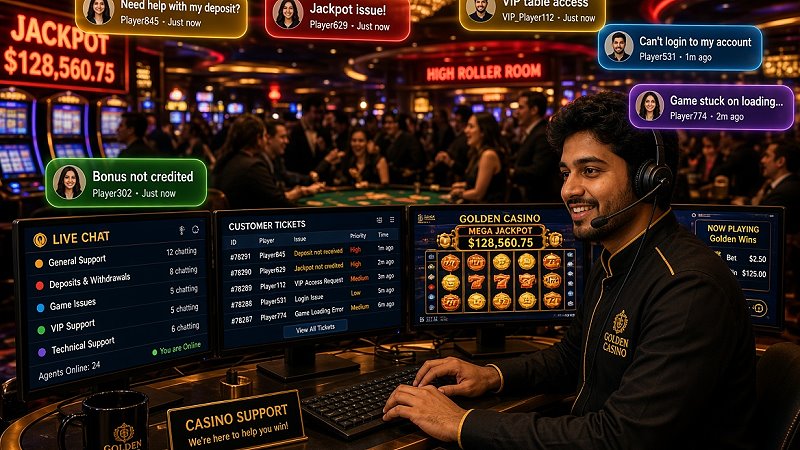
A casino that welcomes 7,500 players a day can expect hundreds of chat requests before lunch, and everyone who writes in judges support by one test: how long the reply takes. Extra hires rarely fix slow answers on their own. A schedule built from real numbers, a sensible spread of shifts, and well-trained agents do.
Start With the Numbers, Not the Org Chart
Many teams hire first and plan later, which leads to crowded afternoons and empty nights. Working backward from expected chat volume avoids that trap.
Estimating Daily Chat Volume
Not every player will open a chat. Contact rates vary by brand, so your own data is the best guide. This example assumes 12%, which translates to about 900 chats per day for 7,500 players.
Next comes average handle time. If a typical chat takes 8 minutes, that’s 7,200 minutes, or 120 hours of conversation every day.
Turning Volume Into Headcount
Chat has one big advantage over phone support: agents can handle multiple conversations at once. Four adjustments turn raw conversation time into a staffing plan:
- Concurrency: With agents running two chats at a time, 120 hours of conversation needs about 60 agent-hours.
- Occupancy: Nobody can be busy 100% of the time. At a healthy 75% target, you need about 80 agent-hours.
- Shrinkage: Breaks, training, meetings, and sick days usually eat up around 30% of scheduled time. That pushes the total to roughly 114 scheduled hours per day.
- Shifts and people: That works out to about 14 eight-hour shifts a day, or around 20 full-time agents across a seven-day week.
Twenty agents are a modest team. Where you place them across the day matters far more than the total.
Building Shifts Around Real Traffic
Player traffic is never flat: evenings and weekends run busiest, while early mornings stay quiet but never empty. If 40% of your chats land between 7 p.m. and midnight, that’s about 72 per hour. At 75% occupancy, with each agent running two conversations at once, one person can handle roughly 11 chats an hour, so you’d need about 7 agents during that window.
Before sunrise, the picture flips, with perhaps 10 or 12 chats an hour. The math says one agent is enough, yet a single person can’t take a break or handle a complex payment case without leaving the queue unattended.
One shift pattern that fits these numbers:
- Early shift (6 a.m.–2 p.m.): 3 agents for morning withdrawal questions and overnight follow-ups.
- Mid shift (11 a.m.–7 p.m.): 3 agents, overlapping with the early crew during the lunch rise.
- Late shift (4 p.m.–midnight): 5 agents for the start of the evening peak.
- Peak booster (7 p.m.–11 p.m.): 2 part-time agents for the busiest hours.
- Night shift (11 p.m.–7 a.m.): 2 agents minimum, one of them a senior who can make judgment calls.
Added up, these shifts give 15 agents and 112 agent-hours a day, close to the 114 the math calls for. Staggered start times also mean no open case is left without an owner when one group signs off.
Matching Agents to Languages and Topics
Volume is only half the picture; the other half is who is asking. Players at NVCasino online can deposit in euros, Polish zloty, Romanian lei, or Hungarian forint to play online slots and live casino games, so a chat desk serving that mix needs agents who can answer in more than English. A practical approach is to staff the main language around the clock and cover smaller markets during their local evening peaks.
Topics follow a similar pattern. Questions about payments, bonuses, and account checks fill most shifts, so a strong first-week training plan usually covers:
- Deposits and withdrawals: processing times, common failure reasons, and when to escalate.
- Identity verification: which documents are accepted and why a check might be delayed.
- Bonus terms: wagering rules explained in plain words, with no guessing.
- Responsible gaming tools: how to set limits, cool-off periods, and self-exclusion, and how to spot a player who may need them.
- Tone and escalation: when to stay calm and firm, and when to hand a chat to a supervisor.
Saved replies help, but agents should adjust them for each player, since a canned answer in the wrong spot makes a frustrated person angrier.
Measuring Whether the Schedule Works
A schedule is a forecast, and forecasts drift. A weekly check of planned versus actual volume shows whether evenings are understaffed or mornings carry spare agents.
Speed alone doesn’t prove good service, so track first-contact resolution and post-chat ratings alongside first response time. An agent who replies in 20 seconds but solves nothing hasn’t helped anyone, while one who takes a minute and closes the case has.
Check overnight figures separately, since a quiet queue can hide long waits on complex cases like large withdrawals.
Let the Numbers Set the Schedule
Round-the-clock chat for 7,500 daily players doesn’t need a huge team. It needs honest math, shifts shaped around real traffic, agents who speak the players’ languages, and training built around the questions that keep coming back. Start with your chat volume, add realistic time for breaks and shrinkage, and never leave one person alone overnight. Review the numbers monthly, because player habits change and the schedule should follow.

WA on Facebook - https://www.facebook.com/wrestlingattitude/
WA on Facebook (Women's Wrestling) - https://www.facebook.com/WrestlingDivas/
WA on X/Twitter - https://x.com/wa_wrestling
WA on Instagram (Women's Wrestling) - https://www.instagram.com/wa_wrestlingattitude/
WA on Google News - https://news.google.com/publications/CAAqBwgKMJf3owsw2oG8Aw
WA on Bluesky - https://bsky.app/profile/wrestlingattitude.bsky.social